

Why a Stent Is Used
- Narrowing from a tumour pressing on the airway from outside
- Tracheal stenosis that keeps coming back after dilation
- Collapse of weak airway walls
- A leak between the windpipe and food pipe (tracheo-oesophageal fistula), which a stent can seal
Types of Stent
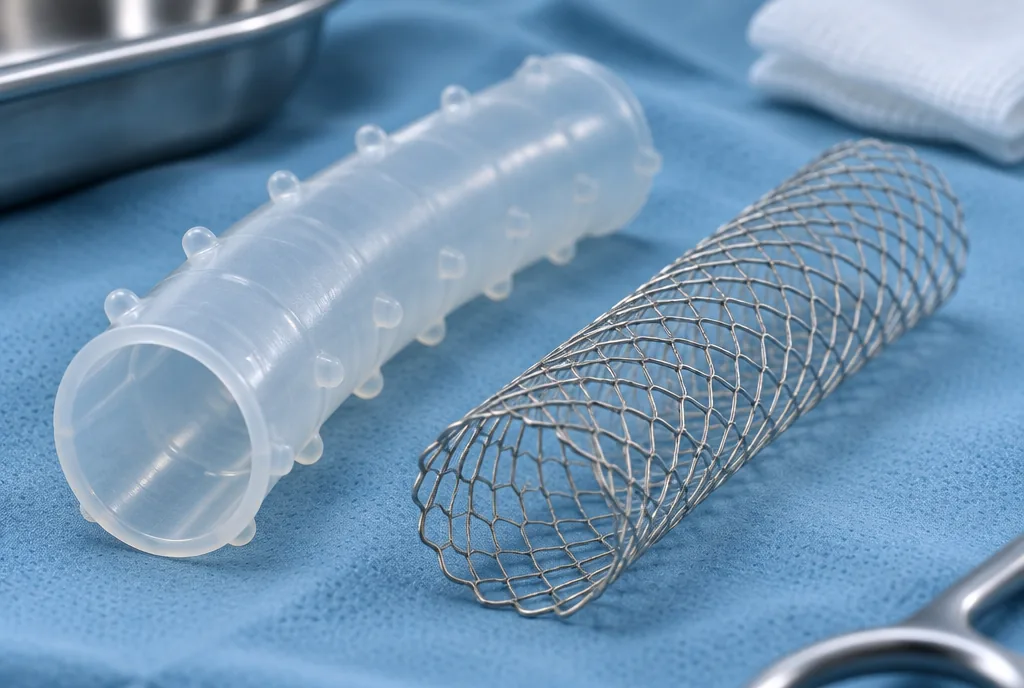
Silicone stents are placed with a rigid bronchoscope and can be removed later. Metal stents are thin, self-expanding mesh tubes, used mainly for narrowing from cancer. Dr Karan chooses the type, size and length from your CT scan and bronchoscopy.
How It's Placed
Usually under general anaesthesia, using a rigid or flexible bronchoscope. The narrowed part may first be widened with a balloon or cleared of tumour, then the stent is placed and checked. Many people breathe more easily soon after.
Living with a Stent
- Use saline nebulisation as advised, to keep phlegm thin so it doesn't block the stent
- Keep follow-up bronchoscopies to check the stent's position
- Tell us at once about new breathlessness, noisy breathing, blood in phlegm or a bad cough, as the stent can move or block
Common Questions
Is a stent permanent?
Silicone stents can be removed when no longer needed. Metal stents are harder to remove and are used mostly in cancer.
Can I feel the stent?
Most people get used to it. A cough is common at first.
Can I eat normally with a stent?
Yes. An airway stent is in the windpipe, not the food pipe.
Medically reviewed by Dr Karan Singla, 16 Nov 2026