

What Is EBUS-TBNA
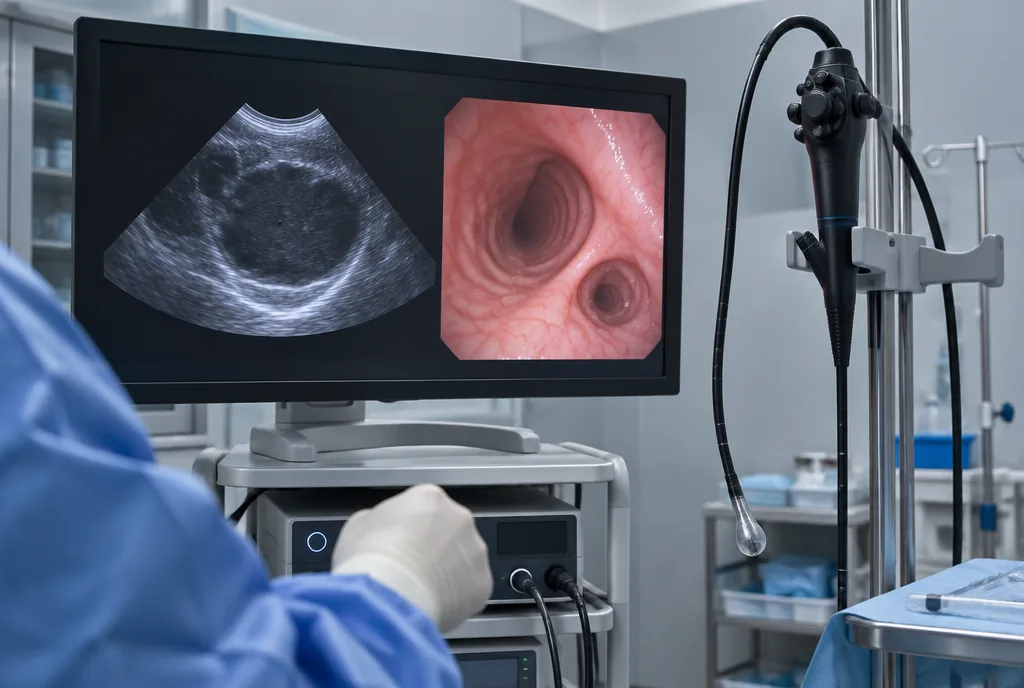
The EBUS scope is a flexible bronchoscope with a small curved (convex) ultrasound probe at the tip. Lymph nodes and masses that sit outside the airway wall cannot be seen with a camera. The ultrasound shows them as a fan-shaped picture on the screen, along with nearby blood vessels, so the needle can be guided safely.
A fine needle is passed through the airway wall into the lymph node or mass, under live ultrasound view, to collect cells and small tissue samples. These are sent to the laboratory for testing.
Why Is It Done
Dr Karan may advise EBUS-TBNA:
- To diagnose lung cancer and find out whether it has spread to the lymph nodes in the chest (staging), which decides the treatment
- To find the cause of enlarged lymph nodes seen on a CT or PET-CT scan
- To diagnose TB of the lymph nodes in the chest
- To diagnose sarcoidosis
- To sample a mass lying next to the windpipe or the main airways
How Is It Done
- Before it starts: you change into a gown, a cannula is placed in your hand, and your oxygen level, pulse and blood pressure are monitored throughout.
- Numbing and sedation: a spray numbs your throat. You are given sedation through the cannula, or a general anaesthetic, so most people remember little of it.
- The scope: a mouth guard protects your teeth, and the EBUS scope is passed through the mouth into the windpipe. You keep getting oxygen throughout.
- Finding the node: the ultrasound probe is pressed gently against the airway wall to find the lymph node or mass, and the blood vessels around it.
- Sampling: a fine needle is passed through the airway wall into the node, usually several times, to collect enough cells.
- How long: usually 30 to 60 minutes. You then rest for 1 to 2 hours, and most people go home the same day.
How to Prepare for EBUS-TBNA
- Scans: a recent CT scan of the chest is needed. Bring the films or CD, and your PET-CT if you have had one.
- Fasting: nothing to eat or drink for about 6 hours before. Take your usual morning medicines with a small sip of water unless told otherwise.
- Blood thinners: tell Dr Karan if you take aspirin, clopidogrel, warfarin or any other blood thinner. Some need to be stopped a few days before. Stop them only on his advice.
- Diabetes: ask about your insulin or diabetes tablets on the day, since you will be fasting.
- Tell us about: asthma, heart disease, allergies to any medicine, loose teeth or dentures, and pregnancy.
- Tests before: blood tests, and sometimes an ECG, may be needed. Dr Karan will tell you at your consultation.
- Come with someone: an adult must take you home. You must not drive after sedation.
After EBUS-TBNA
- Eating and drinking: nothing to eat or drink for about 2 hours, until the numbness wears off. Start with a small sip of water. If it goes down without coughing, you can eat and drink normally.
- For the rest of the day: do not drive, use machinery, drink alcohol or sign important documents for 24 hours after sedation. Rest at home.
- What is normal: a sore throat, a hoarse voice or a mild cough for a day or two, and small streaks of blood in your phlegm for a day.
- Medicines: restart your usual medicines as advised. Restart blood thinners only when Dr Karan tells you to.
- Results: most results take a few days to a week. TB culture can take a few weeks, and extra tests on cancer cells can take longer. Dr Karan goes through them with you at a follow-up visit.
Come straight away or call 112 if you have worsening breathlessness, chest pain, more than a few spoonfuls of blood in your cough, or a high fever after the day of the test.
Common Questions
Is EBUS-TBNA painful?
You are sedated or under anaesthesia, so most people remember little of it. A sore throat for a day is common.
Will I need surgery to get a diagnosis?
For lymph nodes next to the airways, EBUS-TBNA often gives the answer without a cut on the chest. Dr Karan advises what suits your scan.
What if the result is not clear?
Sometimes the sample is not enough for a diagnosis. Dr Karan then explains the next step, which may be a repeat test or another kind of biopsy.
Will I need to stay overnight?
Most people go home the same day after a short rest.
Medically reviewed by Dr Karan Singla, 16 Nov 2026