

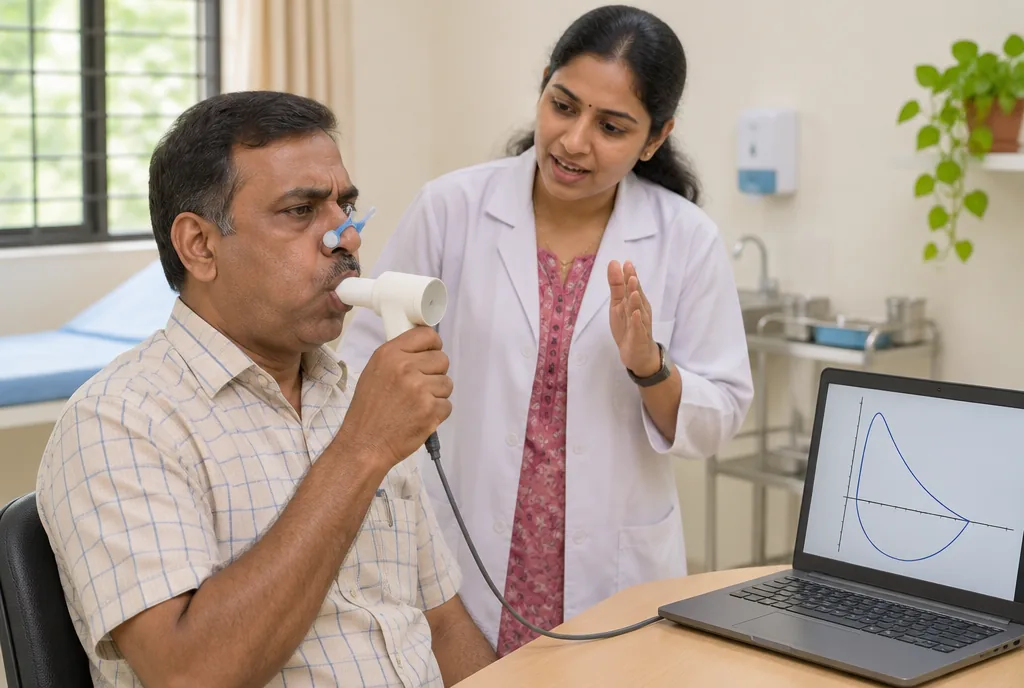
Spirometry (PFT)
You breathe in fully and blow out as hard and fast as you can into a mouthpiece, a few times. It's often repeated after an inhaler puff. It takes about 20 to 30 minutes.
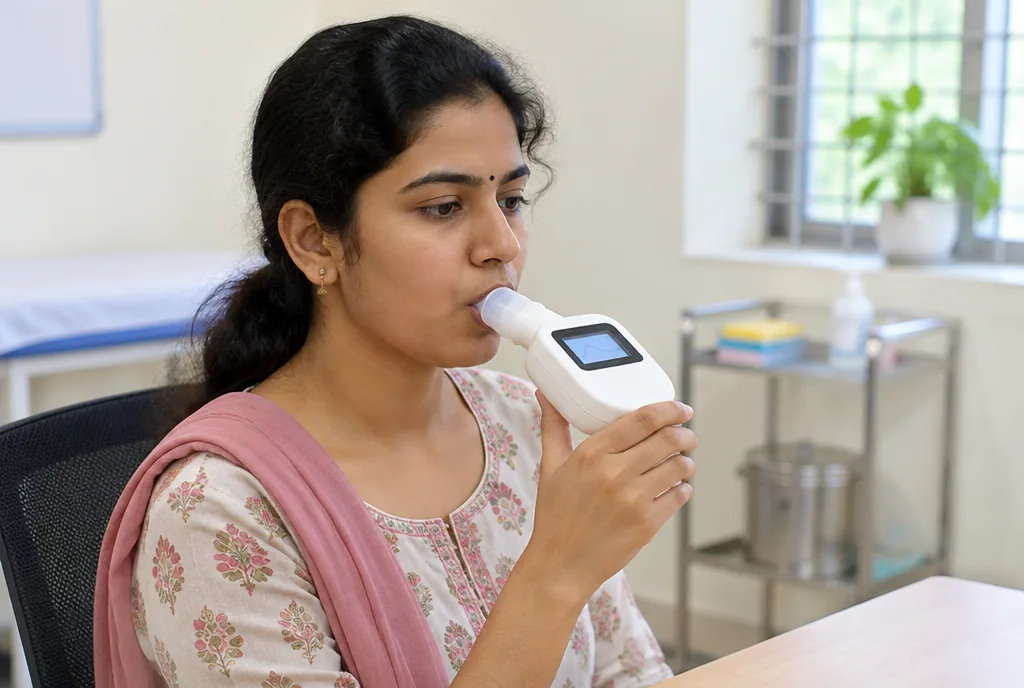
FeNO Breath Test
You breathe out slowly and steadily into a handheld device for about 10 seconds. It measures nitric oxide, a marker of allergic airway inflammation, and helps confirm asthma and fine-tune steroid inhaler doses.
How to Prepare
- Don't smoke, eat a heavy meal or exercise for at least 1 hour before.
- Ask us whether to skip your inhalers before the test.
- Wear loose clothing.
Cost
Ask us for the current test fee when you book.
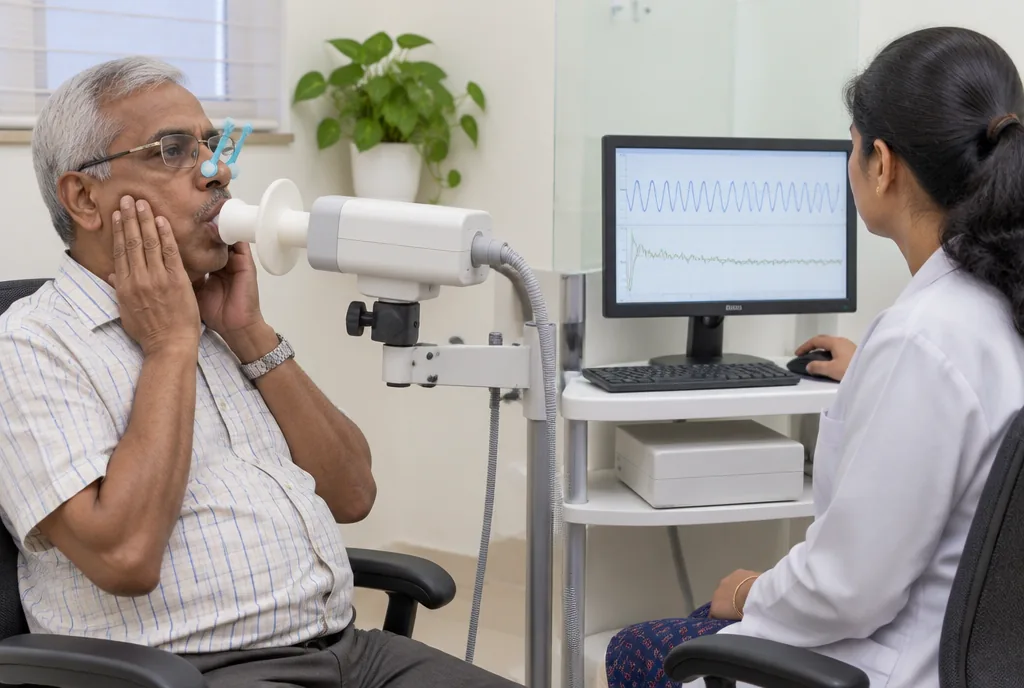
Impulse Oscillometry
You breathe normally through a mouthpiece while small pressure waves measure how much the airways resist airflow. It needs no forced blowing, so it suits children, older adults and anyone who finds spirometry hard, and it picks up changes in the small airways.
Why the Test Is Done
- Breathlessness, a long-lasting cough or wheezing
- To confirm asthma or COPD, and check how severe it is
- To track whether treatment is working
- Before some surgeries
- For smokers, and people who work with dust, fumes or chemicals
- To follow lung scarring (ILD) over time
What the Numbers Mean
| Measure | What It Is |
|---|---|
| FEV1 | Air you can blow out in the first second |
| FVC | All the air you can blow out after a full breath in |
| FEV1/FVC ratio | A low ratio means the airways are narrowed, as in asthma and COPD |
| Peak flow (PEF) | The fastest speed you can blow out |
| Response to inhaler | A clear rise after the inhaler points towards asthma |
Obstructive and Restrictive Patterns
In an obstructive pattern the airways are narrowed, so air comes out slowly. Asthma and COPD cause this. In a restrictive pattern the lungs hold less air, which can happen with lung scarring, chest wall problems or weak breathing muscles. Further tests confirm the cause.
Tell us before the test if you have: had a heart attack, eye, chest or abdominal surgery in the last few weeks, chest pain, are coughing up blood, or recently had a collapsed lung. The test may need to wait.
After the Test
You can go back to normal activities straight away. Spirometry results are ready as soon as the test finishes, and Dr Karan explains what they mean for your treatment.
Peak Flow at Home
A small peak flow meter lets you track asthma day to day. Blow three times, morning and evening, and note the best reading. A fall below your usual numbers warns of a flare before symptoms get bad.
Spirometry Step by Step
- Your height and weight are measured, because predicted values depend on them.
- A soft clip goes on your nose so all the air goes through the mouthpiece.
- You breathe in as deeply as you can, then blow out as hard and fast as possible and keep going until told to stop, about 6 seconds.
- This is repeated at least three times to get consistent readings.
- If needed, you take a few puffs of an inhaler, wait about 15 minutes, and the test is repeated.
Common Questions
Is a PFT painful?
No. It needs effort, and some people feel lightheaded for a moment after blowing out hard.
Can I take the test with a cold?
It's better to wait until a fresh chest infection settles, usually 2 to 3 weeks, unless the doctor needs it sooner.
Why is the test repeated after an inhaler?
If breathing improves clearly after the inhaler, it points towards asthma.
How long does it take?
About 20 to 30 minutes for spirometry. FeNO takes a few minutes.
Can children do a PFT?
Spirometry usually from about 5 or 6 years. Impulse oscillometry suits younger children.
What is a normal result?
Results are compared with predicted values for your age, height and sex. Normal is a range, not one number.
Is FeNO the same as spirometry?
No. Spirometry measures airflow. FeNO measures airway inflammation. They are often done together.
Can a PFT detect lung cancer?
No. A PFT shows how the lungs work, not what is inside them. Imaging such as a chest X-ray or CT scan is used for that.
Medically reviewed by Dr Karan Singla, 16 Nov 2026