

Warning Signs
- Glasses power, especially cylinder, changing at almost every check
- Blurred or doubled vision even with new glasses
- Glare and halos around lights
- Frequent eye rubbing, often with eye allergies
Diagnosis
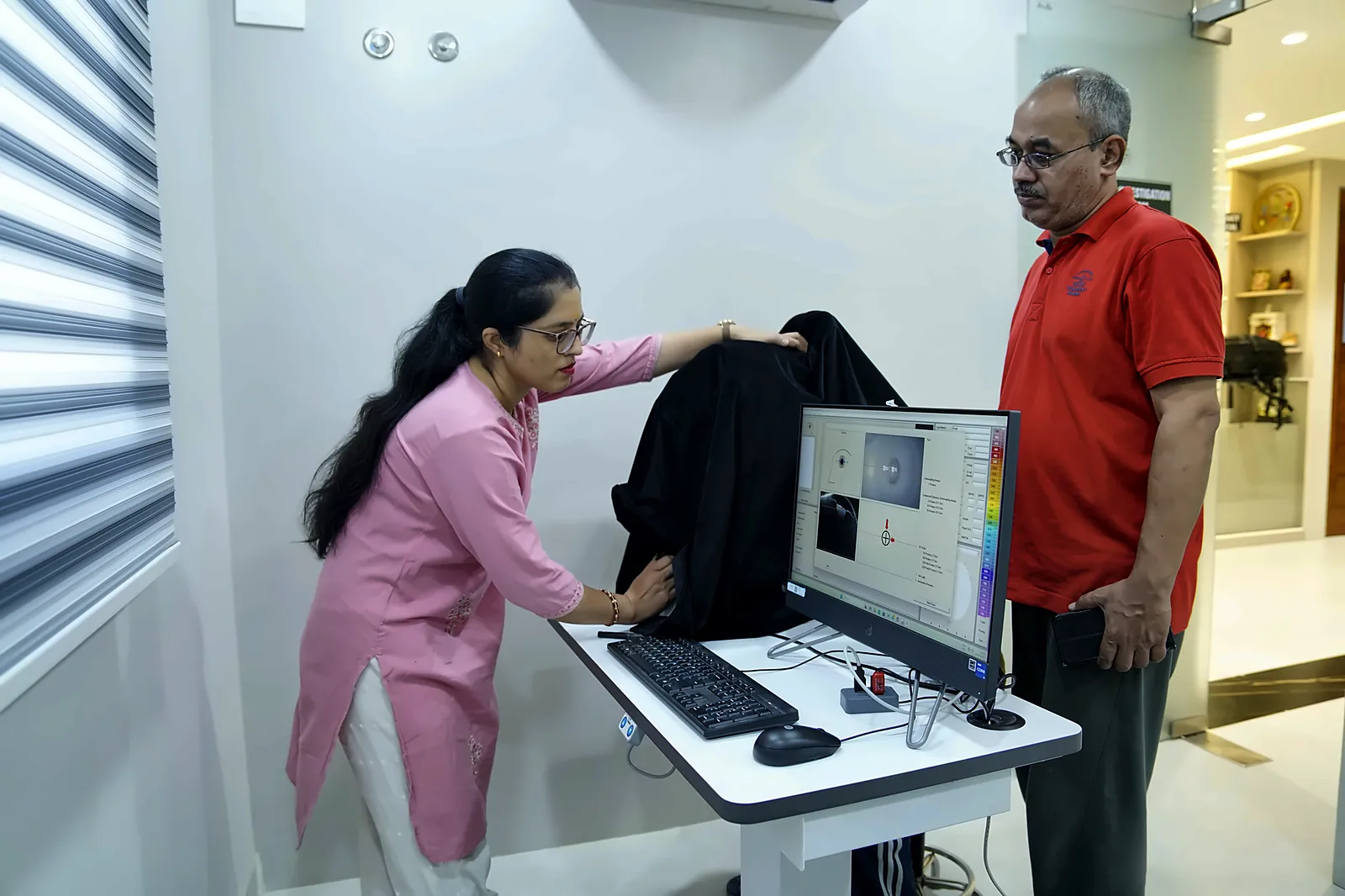
A corneal map (topography or tomography) shows the shape and thickness of the cornea. Repeat maps show whether it is getting worse. The corneal topographer scans the cornea to measure its shape and thickness, for a baseline and at every follow-up.
Treatment
- Corneal cross-linking (C3R). Riboflavin drops and UV light strengthen the cornea to slow or stop it getting worse. It doesn't reverse the change, so it works best done early.
- Glasses and special contact lenses. RGP or scleral lenses improve vision in moderate keratoconus.
- ICL or other procedures for selected stable eyes.
- Corneal transplant for advanced cases. See Cornea.
What Causes It
The exact cause isn't fully known. Keratoconus runs in some families, and it is linked to eye allergies and frequent eye rubbing. Children with spring catarrh (vernal keratoconjunctivitis), a strong itchy eye allergy, are at higher risk because they rub their eyes so much.
Stages of Keratoconus
| Stage | What You Notice | Usual Approach |
|---|---|---|
| Early | Cylinder power rising, but glasses still give clear vision | Regular scans, and C3R if it is getting worse |
| Moderate | Glasses no longer give clear vision | C3R if getting worse, and special contact lenses for vision |
| Advanced | A thin, sometimes scarred cornea, and lenses hard to wear | Special lenses, or a corneal transplant |
How C3R Is Done
The eye is numbed with drops. Depending on the method, the thin surface layer of the cornea is removed (epi-off) or left in place (epi-on). Riboflavin (vitamin B2) drops soak into the cornea, then a controlled UV light is shone on the eye. A bandage contact lens goes on at the end. The whole procedure takes about an hour, and you go home the same day.
After C3R
Expect watering, light sensitivity and discomfort for a few days, mostly with epi-off. The bandage lens comes out after about a week. Vision can be hazier for a few weeks before it settles. Follow-up scans at intervals show whether the cornea has stabilised.
Contact Lenses for Keratoconus
Special lenses create a smooth front surface over the irregular cornea. RGP lenses are small rigid lenses that sit on the cornea. Scleral lenses are larger, vault over the cornea and rest on the white of the eye, so they are often comfortable on an irregular cornea. Fitting usually takes more than one visit.
Keratoconus and LASIK
LASIK thins the cornea, so it isn't done in eyes with keratoconus. This is one reason every LASIK candidate gets a corneal map first, and some people find out they have early keratoconus at that test.
Living with Keratoconus
- Stop rubbing your eyes. Use cold compresses and the allergy drops you are prescribed for itching.
- Keep your follow-up scans, usually every 6 to 12 months while you are young, or as advised.
- Get brothers, sisters and children checked, especially if they have allergies or changing glasses power.
Corneal Transplant for Keratoconus
When lenses can no longer give useful vision, or the cornea is scarred, a corneal transplant replaces the damaged part with donor tissue. In keratoconus this is often a partial thickness transplant (DALK), which keeps your own inner layer. Vision takes several months to settle, and glasses or contact lenses are usually still needed after. See Cornea.
Common Questions
Does eye rubbing cause keratoconus?
Frequent rubbing is a known risk factor. Treat the itching instead of rubbing.
Is C3R permanent?
It aims to stop the cornea getting worse over the long term. Follow-up scans confirm it.
Should my child be checked?
Yes, if they have allergies, rub their eyes often, or their glasses power keeps changing.
Can keratoconus cause blindness?
Complete blindness from keratoconus is rare. Vision can get poor in advanced stages, and special lenses or a transplant can often improve it.
When does it stop getting worse?
It usually slows down by the 30s or 40s. It can get worse quickly in teenagers, which is why early C3R matters in young patients.
Can both eyes have C3R?
Yes, if both are getting worse. Usually one eye at a time, a few weeks apart.
Can I wear normal soft lenses?
Sometimes in early keratoconus, but they don't correct an irregular cornea well as it progresses.
Is keratoconus hereditary?
It runs in some families. If you have it, get your brothers, sisters and children checked.
Medically reviewed by Dr Muskaan Bansal, 16 Nov 2026